Showing posts with label fish. Show all posts

Thursday, June 7, 2012

Can I eat this fish?


I struggle with seafood. I know it's good for you (lean protein, omega-3 fatty acids, and so forth) IF it's not chock-full of mercury or other heavy metals, in which case don't eat it all if you are pregnant, nursing, or a young child and only moderately if you are anyone else. I also know that current seafood consumption patterns have the potential to wipe out fish and seafood stocks all across the planet. (Here's a graphic from The Washington Post that illustrates some of the overfishing issues that we currently face.) And I know most of the fish I get is flown or shipped in from somewhere halfway around the world--not a great thought when you aim to live in a way that supports local community and reduces fuel consumption. And then there's the question of farmed or wild? What's better? And perhaps by what yardstick? With seafood, you definitely have to weigh a lot of different factors.

Let's consider some of these factors, starting with sustainability. This topic actually makes me want to chew nails. For one thing, the fish species you thought were sustainable last year, last month, or even last week may not be sustainable today. This week you may be committing an atrocity on fishdom if you buy and eat that kind of fish. It can make you crazy. 

But there are resources to help you stay up to date on what's OK to eat now. In "A Consumer's Guide to Buying Sustainable Fish," Denise Santoro Lincoln notes that your best option is to find a good fishmonger who is passionate about selling sustainable fish and works to keep up with continual changes. She also notes that this isn't really practical for most of us and provides a great list of resources, including Monterey Bay Aquarium Seafood Watch. World Wildlife Fund also has a list of excellent resources, including some country-specific seafood guides. All this information, however, requires that we as consumers put effort into ensuring we are making good choices. And because the state of a fishery can change so drastically from year to year, it's something we have to check into regularly. (Unfortunately, it's not enough to trust that your grocery store is going to do that work for you.) 

Another factor to consider is farmed versus wild. Some of the problems with eating wild-caught fish are of course depletion of wild fish stocks and the problem of bycatch. However, when done poorly, farmed fish can wreak environmental havoc, including habitat damage, pollution and disease, and escapes, possibly of "Frankenfish." So once again, we have to do our research to find out what's a "Best Choice" and what isn't. I have generally avoided all farmed seafood, but it turns out some farmed species are Best Choices after all (oh boy, I can go back to buying and eating mussels; I love mussels).

For some great tips on choosing seafood that's as sustainable and as healthful as possible, check out Lettuce Eat Kale. Just as fruits and vegetables have seasons, so does seafood and it pays to know when those seasons are.

[Update] And it turns out the cod I had for dinner tonight was from a company that sells Certified Sustainable Seafood (thank you, MOM's Organic Market for looking out for me) and pretty tasty as well. If you happen to have a few cod fillets, here's a really simple recipe.

Cornmeal-Crusted Cod Fillets

Ingredients

  • 2-3 cod fillets (if frozen, defrosted), rinsed, patted dry
  • salt
  • ground white pepper
  • 1-2 tablespoons unsalted butter
  • 1 egg
  • 1/4 cup yellow cornmeal (more or less)
  • lemon wedges
Instructions

  1. Melt the butter in a frying pan over medium-high heat. 
  2. Salt and pepper the cod fillets.
  3. Beat the egg with a fork in a bowl (just enough to incorporate the white and the yolk). Put the cornmeal on a plate.
  4. Coat each fillet in egg. Dip the fillets in cornmeal. 
  5. When the butter is foaming and slightly brown, add the fish fillets to the pan. Fry on each side for about 2 minutes per side. (The cornmeal should be golden brown. If it isn't, give it another minute in the pan.)
  6. Remove the cod fillets to a plate and let them rest about five minutes before devouring. Serve with lemon wedges. Great accompaniments (especially in spring/summer) are boiled new potatoes with butter and a sprinkling of chives and a simple salad of lettuce leaves with some oil and vinegar.

Monday, April 11, 2011

I am so over winter food!

I am so bored with food right now. When you eat seasonally, transitioning between seasons is always hard, but this time of year is particularly dreary. You are tired of eating frozen berries and mealy apples, but you know you need to clear out the freezer for all the good new stuff that will come. A few wrinkly sweet potatoes and rock-hard squash (what were those called again, celebration squash?) loiter at the bottom of the veggie basket, up to no good with some wayward onion skins. Most sellers at the winter farmer's market in Leesburg seem tired or bored, waiting for the release of spring and summer, oh sweet explosive gorgeous summer. When Mike says he was hoping to see some vegetables, one seller calls out, "No, won't be any vegetables until the end of the month." Haven't seen the carrot guy with his sweet little jewel-bright roots in weeks. The eggs are gorgeous with their perky, deep orange yolks and becoming increasingly abundant, but I feel as though my capacity to come up with things to do with them is waning along with the variety of foods available to me. I look around at the market, I see cupcakes, goat milk soap, honey, and lots of meats--all good stuff--but somehow much has lost its luster.

So what then? I guess I need to kick it in gear, get inspired, get  creative--try things that I might never try otherwise. Dig out the stuff from the back of the freezer and come up with a way to make it interesting (and good, of course). Try something I haven't done before. I've been toying with the idea of making noodles or pasta for a long time. Maybe now would be a good time for that. Maybe I need to learn to make a different bread (I make most of the bread we eat; when we first tried to eat locally and without a lot of industrial ingredients, we discovered quickly that most commercial bread is chock full of weirdness). I tried making sourdough once and failed sadly (tough stuff--should have used it for insulation or in place of concrete barriers), and I've been meaning to try again with another recipe, but I haven't gotten around to it yet.

What I have tried to do recently is to institute Meatless Mondays and to start eating more fish. What both of these attempts have taught me is that I know less about some kinds of food and cooking than I thought. Creating vegetarian meals is hard because they frequently lack a centerpiece; it all seems like sides. They are often complex, too. I started my Meatless Monday career with a great pizza, but it was a fussier recipe than I typically do on a weeknight. (I will be using the pizza dough recipe again, however.)

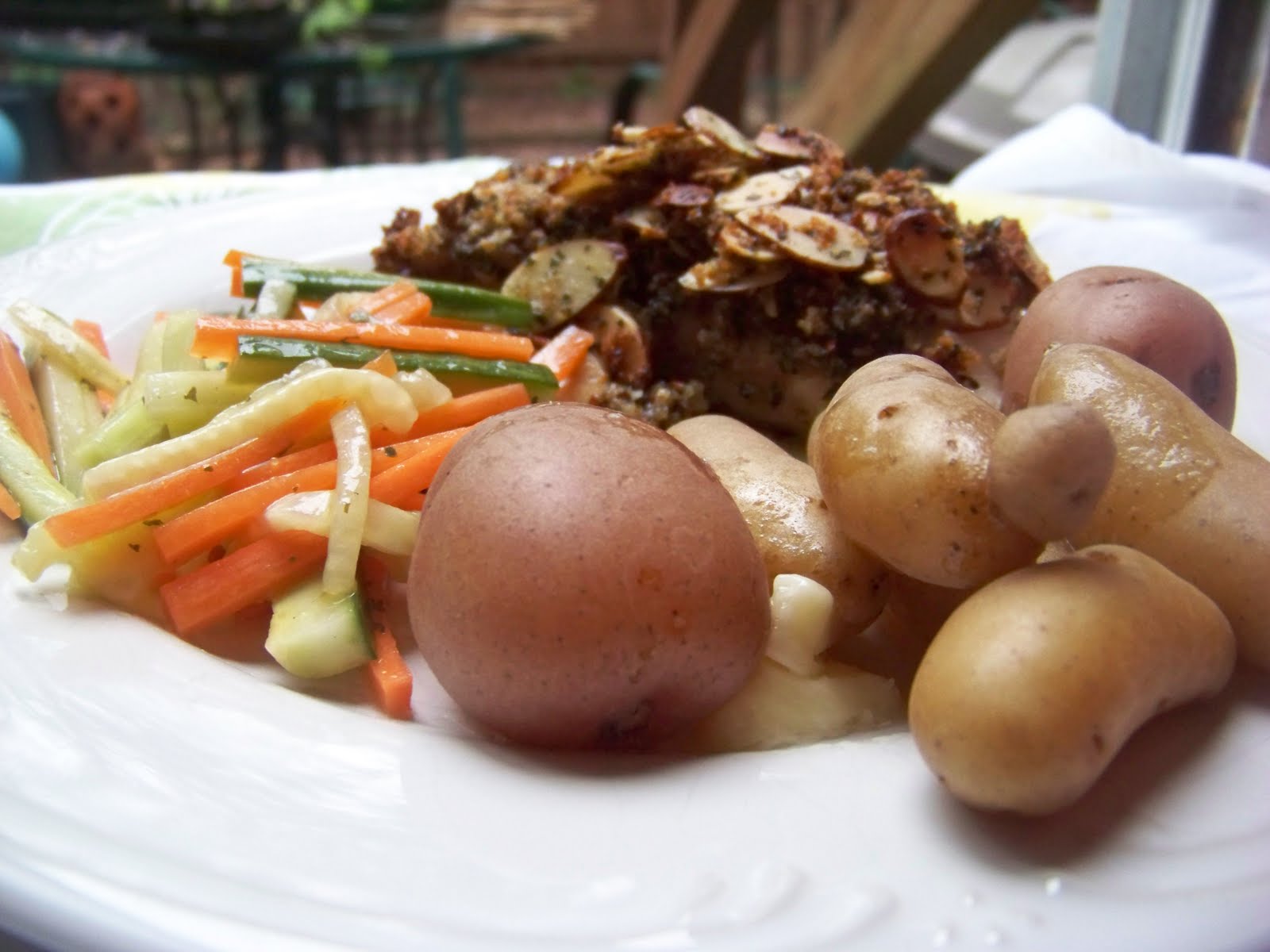
And, despite my Nordic heritage, I am not much of a fish eater or cook. So far I have made one fish recipe that I like (the recipe is at the end of this post), which is a traditional Swedish dish that, believe it or not, I used to eat in grade school and like (unlike fish balls--gag--or blood pudding--gag even worse). In Swedish it's called mandelfisk, which translates into almond fish, and it's just a nice yummy, breaded fish with nuts (and lots of butter). I like to eat it with boiled Yukon Gold potatoes (or any other nice, buttery yellow-skinned potato) with some melted butter and parsley and some grated carrots, perhaps with a squeeze of lemon or a dash of vinegar. Simple, clean tastes that bring up memories of better times as a kid in Sweden. Like when I spent a week on my aunt and uncle's boat in the Stockholm archipelago, eating a fresh fish stew with butter melting into rings in it ("leaden circles dissolved in the air"), giggling with my cousin while rosy, hot-faced, and sweetly tired from a long day in the sun and wind.


Mandelfisk
4 small files of white-fleshed, flaky fish (I use Chesapeake rockfish, because it's the one fish that I know I can get locally; it's a little strong, but still very tasty)
4 Tbsp butter
1 cup breadcrumbs (fresh preferably, which are really easy to make if you have a food processor: just throw some chunks of fresh bread in and whir it up until it's fine)
1/2 cup flaked almonds (or if you've got whole almonds, you can just chop them, which I discovered in a pinch)
a bunch of fresh parsley, chopped (if you have it); if not, use a Tbsp dried
1 clove garlic, chopped or crushed

  1. Heat your oven to 400 degrees (Fahrenheit)
  2. Butter a baking dish
  3. Rinse your fish files in cold water, pat dry with paper towels, salt and pepper to taste
  4. Place your fish files in the buttered baking dish
  5. Meanwhile, in a pan over medium heat, melt the butter
  6. Add garlic, parsley, breadcrumbs, and almonds; mix everything into a kind of crumble and take it off the heat
  7. Pack the breadcrumb mixture evenly onto the top of your fish files
  8. Put the fish in the oven and let it bake for about 20 minutes, or until the fish is flaky and the breadcrumb mixture is golden brown