Showing posts with label spring onions. Show all posts

Wednesday, April 25, 2012

Spring pasta with salmon and sugar snap peas--and a look back on an independent year


A year ago last week was my last day as a wage slave. My plan had been to go out on my own and start a food blog and share my passion for seasonal and local food; the future was grand, rosy, exciting. After years of feeling stuck in jobs that didn't seem to appreciate all that I had to offer and were leaving all my brilliance and skills on the table, I was going to get out on my own and put all that smart and talented out there. (And I was going to get my house in order, get in shape, and about a dozen other things.)  

Well, I started a freelance career as an editor, proofreader, and writer, and I started a food blog. I quit some bad habits. I ran a lot. Some portions of my house got clean--for a while. But only now do I begin to understand how differently I need to think about my work, to plan my life, to organize my time. Only now do I realize several hundred thousand food bloggers are out there, sharing their passion, and doing it with way prettier pictures and often with far more graceful prose. Only now do I realize that, yeah, I am smart and talented, but a lot of people are smart and talented, and many are way more trained and knowledgeable than I am. Ouch.

So those were some lessons: I wasn't nearly as good and smart as I thought. I wasn't nearly as passionate about food as I thought. Finding clients wasn't so easy, especially after the funding for my first big one dried up. There are always going to be people who are more talented, more committed, less diffused over multiple priorities. Less confused really. A heck of a lot more focused and driven.  

As you can imagine, that hurt. Especially the part about not being as good and smart as I thought I was. Yeah, that stung.

But it was an honest lesson, a real lesson. I wouldn't say I am humbler now, but I am gaining some clarity and perspective. I am clearing away some imposed rules, some imposed ways of thinking, some imposed parameters for beauty. And that's good, because I get to try and start fresh, to see with new eyes, to start to remember the first look and feel and smell of creativity, what that was like, so many years ago when the block of clay first hit the table.

And all I really meant to do tonight was share a recipe for pasta with sugar snap peas and salmon, and here I am, off on this tangent. Oh well. Here's how to make the pasta. It's really good: light, fresh, pretty in green and pink, with a nice crisp crunch from the peas--everything you'd ever want in a spring pasta. So get thee to the farmer's market and find some sweet crunchy sugar snaps!  

Pasta with salmon and sugar snap peas
  • 12 oz. salmon fillets (whatever's in season, or wildcaught frozen and defrosted)
  • 1 lb pasta (I used rombi in this recipe)
  • 2 Tbsp unsalted butter
  • 1 Tbsp finely chopped shallots
  • 3 spring onions, green tops removed, sliced thinly
  • 2 cups sugar snap peas, ends and strings removed
  • juice from a half lemon
  • 1 cup heavy cream
  • 1/2 tsp Dijon mustard
  • salt, pepper, dried thyme
  1. Cook the pasta according to package instructions. (Start boiling the pasta about the same time you start the fish so they finish at the same time.)
  2. Rinse the salmon fillets in cold water, dry them with paper towels, and salt and pepper them. Prepare your produce (shallots, spring onions, and sugar snap peas).
  3. Melt the butter over medium heat in a large deep pan.
  4. When the butter bubbles and browns slightly, place the salmon fillets in the pan. Sprinkle the lemon juice all over the fillets. Let them cook for 1-2 minutes, and turn them over to cook for another minute on the other side. Take them out of the pan, put them on a plate tented with foil (keeps them warm). 
  5. Add the shallots and the spring onions to the pan, cook until they soften (about 2 minutes). 
  6. Add the sugar snap peas to the pan, let them cook for 2 minutes. 
  7. Add the heavy cream and the Dijon mustard to the pan. Let the sauce cook until it thickens (about 2 minutes). Season with salt, pepper, and thyme to taste. 
  8. Add the cooked pasta to the sauce in the pan and mix it all together. Turn off the heat. 
  9. Removing the skin, break the salmon into flaky pieces and mix them into the pasta.
  10. Eat! Enjoy! Even my five-year old liked this:


Tuesday, May 10, 2011

How to cook and dance at the same time

This is a public service announcement: Don't grate cheese and boogie at the same time.

I've been hammering away for days at a tough editing project, so food has gotten kind of short shrift at the homestead (Sorry family). Last night we got takeout. Who knows what we ate the day before. My head has been lost in a thick jungle of words that haven't made a whole lot of sense, and I had been slashing away with my editorial machete until my arms hurt and I lost my sight to a wicked migraine. Finally, today, I saw some light through the trees and finished up a rough section.

In need of a little R&R, I decided to throw on some tunes while cleaning up the kitchen and preparing my favorite go-to pasta dish. Mike and the Boo weren't home yet, so I decided to listen to ABBA--a nostalgia trip (I grew up in Sweden) and an invitation to dance (and not a favorite of my music snob of a husband).

The first song to come up was I Have a Dream, so I start to sway and sing along. Memories of being eight or nine years old, spending the summer with my cousin Tove in Stockholm, and putting on shows for the family with her started to break over me like crashing waves: "I have a dream/a song to sing/To help me cope with anything/If you see the wonder of a fairy tale/You can take the future even if you fail/" Then, the song rises up to "I believe in angels/Something good in everything I see," and my throat chokes up and tears slide down my face, even as I continue to sway and empty the dishwasher. Song after song, it goes like this: I am crying, my throat is too constricted to sing and yet I continue to force the notes out, and I am wondering: What the hell? It's ABBA, for pete's sake. Why am I crying?

But the crying feels good. It has that weird and wonderful cathartic feeling that laughing at a funeral can have when everyone is remembering someone they loved very much, telling goofy stories, and soaking in gratitude for life and the people who are still there with you. It's pain and it's joy rolled into one rich and overwhelming package--like eating something that's sweet and savory at the same time.

Next song up is Gimme Gimme Gimme (a Man After Midnight), the dishes are done. Time to make the pasta. I shimmy over to where I keep the big pasta pot, pick it up, twirl back to the sink and start filling it with water, toss a handful of salt in. While the pot is filling I get some some high kicks (or maybe not so high) going while I holler my head off (of course the back door is wide open, so I am keeping my eyes peeled for the neighbors). I boogie back to the sink, put the pot on the stove to boil. I grab a spring onion, a bundle of asparagus, two carrots, some bacon, and what's left of a box of sweet peas from the fridge.

I slice the spring onion and the carrots; snap the ends off the asparagus and cut it into one-inch pieces; peel some garlic; cut the ends off the peas. The bacon slides from the package, and "Mamma Mia, here I go again/My, my, how can I resist you?/Mamma Mia, does it show again?/My, my, just how much I missed you." Oh bacon, how much I've missed you. I haven't had any since Saturday. I slice it thinly.

The tears have dried up, the sweat is starting to flow, the bacon goes into a hot pan to render and fry into crispy little bits. "If you change your mind, I'm the first in line/Honey I'm still free, take a chance on me/If you need me, let me know, gonna be around." The water is boiling away, a pound of butterflies is in for a dip. The bacon fat has rendered out, the spring onion slices are in the pan, changing the scent in the room. Molecules tickle my nose, my memory, the smell of my Finnish grandmother's kitchen (crazy as a bedbug, I believe, but I remember the mouth feel and taste of her bread, of green salad with some strange but delicious white salad dressing). Mostly, there's a memory of feeling whole, in the right place, family all around, Tove's dad trying to make us laugh and twirling his handlebar mustache, the bowl of salad being passed around the table. Cool Nordic summer light drifts through the window. I am crying again. It all comes from a time when I was little, before my family broke irrevocably, and little has been whole since. In go the carrots, the asparagus, and the peas.


I bring back Gimme Gimme Gimme (a Man After Midnight) and pull out all the stops now. I am dusting off what steps I remember from years of dance classes while the vegetables cook in the pan and the pasta boils. I am busting some serious moves, even though I don't remember my joints being this stiff when I did them before. I am going to hurt tomorrow. I grate the Parmigiano Reggiano while bopping around. Turns out to be a mistake when I slice some skin off my thumb. No blood in the cheese though, and that's what matters.

Pasta is down to about three minutes on the boil, I pour a cup of half and half into the pan with the vegetables and add a cup of grated cheese (more actually, but I always like extra cheese). The sauce thickens in minutes. In go thyme and white pepper. When the pasta is cooked, I strain it, add it to the sauce, and stir. Dinner's done. Mike and the Boo aren't home yet. They went to the park. So I keep on dancing until they get home, and it's time to eat.


Base recipe for go-to pasta (will make enough for at least two dinners, which is helpful if you have little time to cook):

  • 1 lb dried pasta of any variety (butterflies and rotini are my usual picks) (cooked according to package directions--once again, when I make my own pasta, you will know about it)
  • Any combination of vegetables that are in season and hold their shape pretty well (in summer, tomatoes and bell peppers are good; fall, I could go with cauliflower cut into bite-size pieces; spring, asparagus and peas are awesome)
  • 4-5 slices of bacon (or more, if you like), sliced thinly (make sure to render it for the fat to the vegetables in)
  • 2 cloves of garlic, crushed
  • 1 cup half and half
  • 1 cup grated Parmegiano Reggiano
  • thyme, white pepper

Instructions (sans dancing)

  • cook the pasta
  • render the bacon and then let it get crispy
  • add vegetables (start with firmer vegetables that take longer to cook) (keep stirring them)
  • add the half and half and the cheese, season with thyme and white pepper (I don't usually add any salt because there is so much in the cheese and the bacon) and let it thicken
  • strain the pasta
  • add the pasta to the sauce and stir it on the heat
  • You are done! (If you feel like it, you can toss some chopped walnuts, pine nuts, grated cheese, or other things on top, but you really don't need it.)


Wednesday, May 4, 2011

Making food from scratch: Mayonnaise and Maryland Blue Crab cakes

JEBPUKCVF4FJ

I read an article by Kristin Wartman yesterday that made me want to renew my commitment to getting whole ingredients from local producers and making food from scratch. She cites several studies that warn of the dangers of food additives and their additive and cumulative effects. What it comes down to is this: Most food additives are not well studied, but are generally believed to be safe--in isolation. However, on a daily basis people eat dozens (if not more) additives in combination, and we don't really know how they work together. If I have learned one thing from my husband (a molecular biologist who studies obesity, liver disorders, and metabolic syndrome), it's that nothing works on its own in the body.

But making food from scratch is about more than avoiding ill health effects: It's about taking pride in your own ability to make something special. And it's about good taste. Obviously, the results aren't always perfect, and they aren't always consistent. But it can be a lot more fun to exercise your imagination when you have ingredients you've never tried before. It can be surprising when you try putting some things together and discover how great they taste. This purple carrot and fennel salad I concocted to go with some egg sandwiches is a case in point:

Pretty, easy, and delicious: Thinly slice carrots and fennel bulb, add a dash of salt, a splash of olive oil, a splash of red wine vinegar, and some chopped fennel fronds. Fennel and carrots really do play well together! Thanks to Shrimp13 for the inspiration.  
Making food from scratch may seem like a lot of complicated work, but it doesn't have to be. Obviously it takes more effort and care than throwing a frozen dinner in the microwave or picking up some kind of super-jumbo cheap meal from McFastFood King, but the results are usually worth it. Mayonnaise is an example of something that's surprisingly easy, superior in flavor when homemade, and really impressive. (Note: It's only easy if you have a blender or food processor; I have no idea how anyone would ever have the arm strength and coordination to do it without one of these tools.) Here's how to do it (I follow the recipe from Williams-Sonoma's Tools and Techniques):

  • Crack two eggs into a cup. Lift out the yolks with a spoon (be careful not to break the yolks, and you'll be able to use the whites for something like else, like meringues).
  • Put the yolks into the bowl of your food processor and place it into a bowl of hot water. Leave it for about five minutes just to take the chill off the eggs. Test it by sticking a clean finger into the eggs, when the eggs are no longer cold, you are good to go. 


  • Add 1 tablespoon lemon juice (you can substitute a well-flavored vinegar if you don't have local lemons and want to stick to local ingredients) and 1 teaspoon Dijon mustard (I am afraid I have not found a local substitute for this one). 


  • Next, combine olive oil and canola oil to get a total of 1 and 1/2 cups of oil. (The original recipe suggests 3/4 cup of each, but I find the olive oil can be a bit strong, so sometimes I use less olive oil and more canola. But there's no reason not to experiment with different kinds of oils to come up with the combination you like best.)
  • Assemble your food processor with the eggs, lemon juice, and mustard. (Do not add the oil yet.) Start it up at a slow speed. 
  • Start pouring in the oil in a slow and steady stream. This is really important: Do not dump it in quickly. It should look like this:


  • Keep adding the oil slowly and steadily until you have poured it all into the egg mixture. It will take several minutes.
  • When it's done, turn off the food processor. Mix in salt and white pepper to taste (I add about a teaspoon of salt and a generous sprinkling of pepper) and voila, you've got mayo!

Of course, you can use it on sandwiches and make flavored spreads by adding herbs, lemon juice, garlic, and so on. 

Or, you can use some of it to make crab cakes! Thankfully Maryland Blue Crabs are definitely local, and I haven't tasted a better crab. I started with Paula Deen's recipe for crab cakes and adapted it to what I had on hand and to my preferences. Instead of using green onions, I chopped some spring onions that I picked up from the farmer's market a few days ago:

They are about to go under the knife.
My knife has done its dirty work. Mwa ha ha ha!
I eliminated the green bell pepper, the Worcestershire sauce, and the cayenne pepper (unfortunately my four-year old son doesn't like hot food) and substituted fresh breadcrumbs for the cracker crumbs. 


Also, instead of dredging the cakes in flour, I coated them with more fresh bread crumbs: 


Then I fried them over medium-high heat for about four minutes per side and served them up with a nice veggie stirfry. My husband said they were the best crab cakes he had ever had! (Of course, I paid him to say that.)


More pretty, easy, and delicious food: Slice onions into strips, julienne carrots, and thinly slice radishes (these were the first harvest from my garden). Heat oil in a wok, add onions and stir quickly until they are translucent. Add carrots and radishes and stir until they are tender. Add a splash of soy sauce. You can pretty much substitute any veggies that you have on hand. If you have greens, add them last and stir until wilted. 

Saturday, April 30, 2011

Seduced by the first spring vegetables at the farmer's market

Kandinsky didn't like green. In On the Spiritual in Art, he describes it this way:

"Passivity is the most characteristic quality of absolute green, a quality tainted by a suggestion of obese self-satisfaction. Thus, pure green is to the realm of color what the so-called bourgeoisie is to human society: it is an immobile, complacent element, limited in every respect. This green is like a fat, extremely healthy cow, lying motionless, fit only for chewing the cud, regarding the world with stupid, lackluster eyes. Green is the principal color of summer, when nature has outlived the year's time of storm and stress, the spring, and has sunk into self-contented repose." (Kandinsky: Complete Writings on Art, edited by Kenneth C. Lindsay and Peter Vergo, Da Capo Press, 1994, p. 183)

Clearly, Kandinsky never saw a Virginia spring after the leaves have filled in and before the dry heat of summer has cast its dusty, yellowing net. This green gathers sun to itself, transmuting it into a fiery halo that spreads its own light on the day. Not a contented cow chewing its cud, but a fierce green knight driving out the cold, gray ogre of winter.     


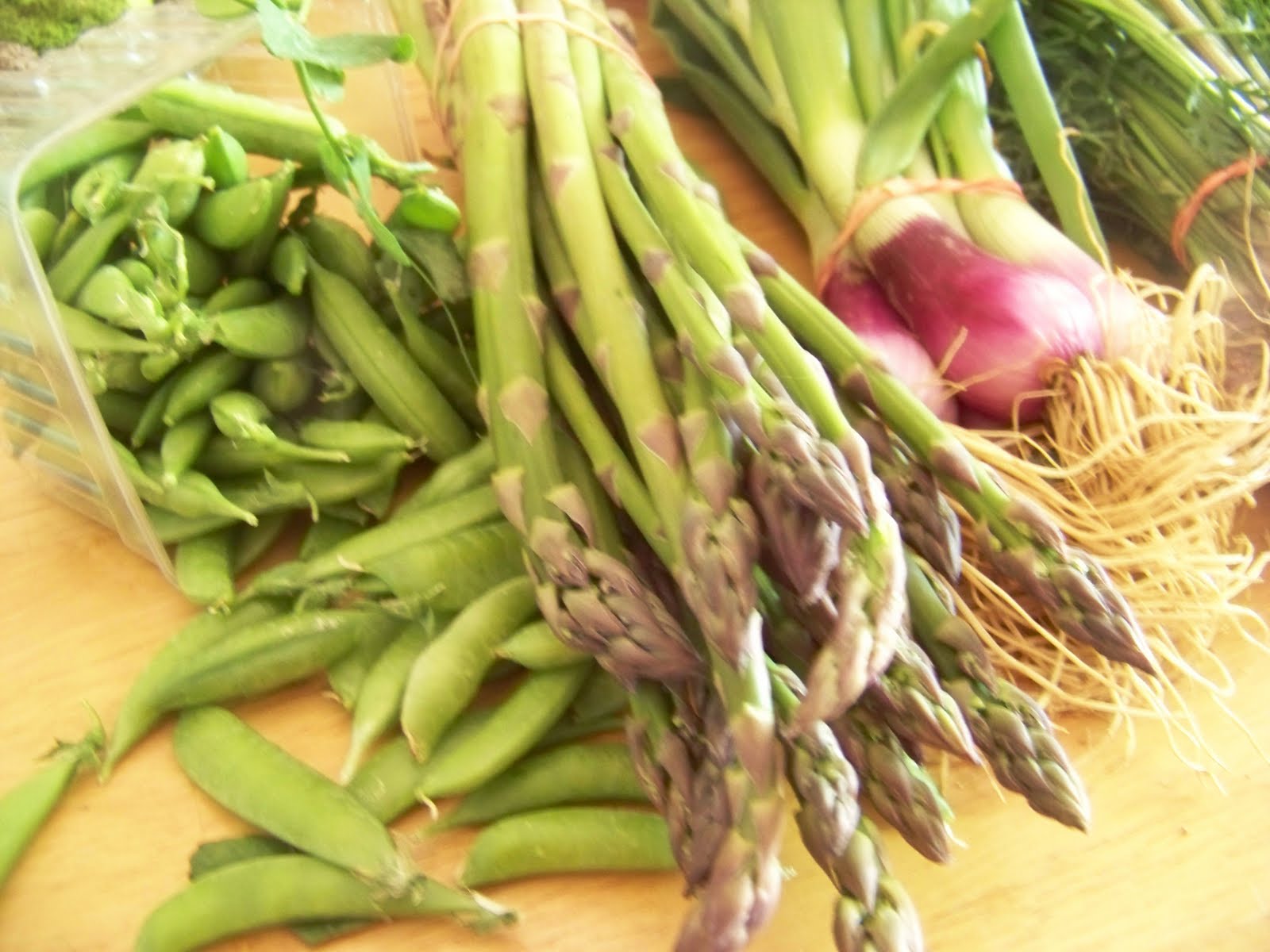
This potent green flashed in my eyes as I drove to the farmer's market, hoping that I might at last find some fresh vegetables and perhaps even some strawberries to dispel the doldrums of winter. And, happily enough, I did. Seduced by the offerings, I bought asparagus, spring onions, peas, fennel, and some ugly little purple carrots.


These may not be at the peak of their flavor, but they have the gift of newness, of being the first green foods to present themselves as miracles of sun and soil and rain. Now, what to do with them? Perhaps try one of Bittman's recipes for the asparagus? With the fresh Haskins bacon that I also purchased at the market? And what of the peas? A sweet addition to a nice pasta, perhaps? Or a stirfry? Perhaps a salad with the carrots?  And what of the fennel bulb? It's not a vegetable I am familiar with, but I am always excited to experiment, to try something new. The spring onions will of course add flavor to all these, and the green tops color. Most important is to have a light touch, to treat this lovely, fresh produce with gentle reverence, allowing their essential selves to sing.  

And what of strawberries, any luck there? Happily yes. Some bumpy, imperfect red beauties. These gems are too special to mess about with at all. Perhaps a few specks of sugar to bring out their flavor. Or even a tiny dusting of white pepper. Again, a light touch to allow their own true nature to shine.   

That's the beauty of real, fresh food, in season: You don't have to do much with it to make something extraordinary.