Showing posts with label strawberries. Show all posts

Sunday, June 24, 2012

Skagen-inspired shrimp toasts: A special treat for Swedish Midsummer


In Sweden, Midsummer is celebrated on the Friday and Saturday right after (or during) the summer solstice. It's one of the most important holidays in the Swedish calendar, comparable to Christmas and New Year. It's basically an old heathen tradition that celebrates sun and fertility at a time when the sun doesn't really set and the beauty of a Swedish summer has finally come to full flower after a long, cold winter. It's party time. People head out to parks and raise a Midsummer pole that they've decorated with flowers and dance around it to traditional music. They wear crowns of flowers in their hair. And of course, they eat. (What celebration doesn't include food, right?)
A friend let me share her picture of a typical Midsummer celebration. 
Traditionally, Swedish Midsummer meals consist of pickled herring (I must confess that this is not one of my favorites), new potatoes served with dill and butter or sour cream (yum), strawberries with cream (or better yet, the beautiful little wild strawberries called smultron). And with that of course, you are supposed to drink shots of snaps, while singing drinking songs. (I settled for some really good hard cider instead.) 


For our Midsummer celebration and the last Swedish meal for Sweden week, I modified the traditional meal a bit. For one thing, I have never been able to eat pickled herring with joy and pleasure. I have choked down a piece or two from time to time to be polite, but that's the best I can do. I was able to get some lovely new potatoes from the farmer's market, along with some fragrant dill. Strawberries are over for the season here, but we do have raspberries and blueberries (the queen's berries) at the market, which had to suffice. And grilling a nice piece of meat is always popular for a summer meal. 


But, I did want my family to try something I have loved since I first had it that says "party" to any person who has ever lived in Sweden: Toast Skagen. However, because I didn't have the right kind of roe for the dish (I was able to find some herring roe at IKEA and the right kind of shrimp*), I am hesitant to call this dish Toast Skagen (especially because that is such a fine and elegant dish and my toasts were more "rustic," but not necessarily in the gorgeous way). Instead, I choose to call them simply Skagen-inspired shrimp toasts. They are so easy to make, it's ridiculous. The only work involved is cleaning the shrimp. But they are so delicious, even my five-year old son loved them and ate every last bit. 


Ingredients
  • 1 500-gram bag of frozen northern shrimp, defrosted, peeled, and cleaned 
  • 4 teaspoons herring roe (or any other flavorful, light-colored roe you can find; don't use a black caviar, it will stain and taste too strong)
  • 4 slices light bread, toasted
  • 3-4 tablespoons mayonnaise
  • four thin slices of lemon
  • juice from half a lemon
  • sprigs of dill for garnish
Instructions
  1. Spread mayonnaise on the slices of toast. 
  2. Sprinkle some lemon juice on the mayonnaise. 
  3. Evenly divide the peeled and cleaned shrimp among the toasts. 
  4. Cut each lemon slice through one side of the rind and all way through to the other side without cutting it completely in half. Twist each half of the lemon slice in opposite directions and garnish the shrimp. 
  5. Spoon some herring roe onto the toasts. 
  6. Add a sprig of dill on each toast.
  7. Enjoy!
* A word about shrimp: I don't like most shrimp. I do, however, like the little pink shrimp that you typically get in Scandinavia known as northern shrimp or prawns (their Latin name is Pandalus borealis, which I just had to share after spending quite some time trying to look them up). Compared with most shrimp that I've found here in the United States, they live up to their shrimply name, so cleaning them takes a long time and is fiddly. I still prefer to get them shell and head on, because their texture is weird when they come pre-cleaned. I've only been able to find them frozen at IKEA, which totally ruins any attempts at eating locally, but this is one of those cases where I definitely prefer an imported product over what I can find here.       

Thursday, May 17, 2012

Strawberry-lemonade jam


When you start making your own food from scratch, especially stuff like bread and mayonnaise, you take a whole lot of pride in what you've accomplished. But it wears off. Eventually baking your own bread doesn't feel so special anymore; it's just a regular part of your week. And once you get the hang of making mayo, you kind of feel like, "Hey, no big."


So far I haven't reached that point with making jam. (And I hope I never do.) Here I am, glowing with pride while eight jars of gorgeous jam cool in the kitchen (plus a little extra insufficient to fill a jar). I decided to call it strawberry-lemonade jam because I love strawberry lemonade (and I thought it sounded good), but really it's strawberry jam flavored with lemon zest, lemon juice, and a hint of lemon verbena to cut the sweetness. It's delicious. And I was able to keep the color of the strawberries--a first in jam making for me. So I am a little puffed up. Let me enjoy my moment of glory. Wait, I have to run to the kitchen and get a spoonful from the partial jar...


Man that's good. Sorry, I'm back. That was wonderful. I am going to tell you how to make the deliciousness yourself in a moment, but first a few tips for making jam:

  • Get the very best berries you can find and preferably ones that haven't been sprayed. I got mine from Reid's Orchard because their berries are extraordinarily good, and they practice integrated pest management, which means they rarely spray their fruits.
  • Jam is not an excuse for using less-than-perfect berries. If you've got ugly berries, trim the ugly parts and try making saft (a Swedish fruit syrup that's delicious as a refreshing drink when mixed with water or you could also pour a little over ice cream). Or bake something with them.
  • Get everything ready before you start cooking the jam, because once you start you will not be able to leave the stove for more than a minute or two. (Lot of hovering over the stove involved in making jam.) So that means wash and sterilize all your jars, juice and zest your lemons, wash the verbena stems, place a plate with five metal spoons in the freezer for testing, and have a ladle and a funnel ready to go.
  • Be careful. Making jam is an activity not dissimilar to making candy. That means temperatures get very high, boiling can get violent, and the jam can overflow. Also, it can spatter and burn, so take care. Maybe wear an oven mitt while you stir. Or cast caution to the wind and gain some badges of honor (I got one on my wrist today).  
  • Don't start making jam unless you have at least 45 solid minutes to devote completely to the task. You can't really start and stop, and you have to be present at the stove through nearly the entire cook time.    

OK, so those are the general tips. Here are the specifics (both ingredients and equipment):

  • 4 lbs hulled strawberries (keep them whole unless they are huge)
  • 2 lbs 10 oz sugar 
  • juice from four lemons (between 5 and 6 ounces, divided)*
  • zest from two lemons (finely chopped or grated)
  • 1 large branch of lemon verbena (optional, but nice)
  • 1 white plate with 5 metal spoons, placed in the freezer to prep them for testing
  • 1 deep thick-bottomed pot that's from 8 inches in diameter (up to 11 or 12) (if you don't have a jam pan,** a stock pot will work just fine)
  • 1 silicone spatula
  • 1 skimmer, placed in a bowl of cold water
  • 1 ladle
  • 1 wide-mouth funnel (you'll usually find these wherever you find canning supplies)
  • 9 clean 8-ounce jars with banded lids, washed, sterilized, and kept hot
  • Any equipment you are using to process the jars (pot with rack, baking sheet and rack, etc.). For information about processing jams (and any canned good) safely, go to the National Center for Home Food Preservation.      

OK, now that you have assembled everything you need, let's get started:

  1. Combine strawberries, sugar, and half of the lemon juice in a pot. Stirring steadily with the silicone spatula, slowly heat the mass. When the berries release a lot of liquid and the berry-sugar mass becomes more liquid, raise the heat slowly to high and bring the mass to a rolling boil. 
  2. Maintain the berry-sugar mix at a high boil for about 25 minutes, stirring once a minute or so, making sure to scrape the bottom with the spatula. If the mass starts to stick to the bottom, lower the heat a bit. Using a skimmer, skim the scum off the top for the first 10 minutes. As you will be standing here for a while watching the mass boil, you will no doubt notice some changes in the jam: First, it will boil up very high, possibly threatening to boil over. Usually consistent stirring will help keep that from happening, but it doesn't always work. Adjust the heat up and down as you work to maintain a strong boil, while avoiding losing half your jam in a sticky, possibly painful, disaster. 
  3. At about the 25-minute mark, the jam will change color, growing darker and glossier, and production of foam will decrease. (Before this, you will notice the jam feeling thicker and the intensity of the boiling increasing.) Mix in the second half of the lemon juice and the lemon zest. (Take the pot off the heating element when you do this to avoid scorching.) Bring the jam back to a high boil for 5 minutes. 
  4. After the 5 minutes, take the pot off the heat and add the sprig of lemon verbena to let it steep while you test the jam. To test the jam, place a small amount of jam liquid on a frozen spoon and return it to the freezer for 3-4 minutes. When you take the spoon out, feel the bottom of the spoon, it shouldn't feel hot or cold. If that's the case, tip the spoon to let the liquid run. If it runs slowly and sort of gums up a bit, the jam is done. If it runs fast, let the jam cook for another 5 to 10 minutes and test it again. 
  5. If the jam was done on your first try, let the lemon verbena steep for another 5 to 10 minutes. Before you put the jam into the jars, remove the lemon verbena and toss it.
  6. Using the ladle, pour the jam into the sterilized jars, leaving 1/4 inch room at the top of the jar. You will get 7 to 9 8-ounce jars of jam. 
  7. Process the jars as directed. Except maybe one that you set aside to "test" for flavor to make sure it's OK. Make sure to refrigerate any open jars. 
  8. Enjoy it. It should be good for 6 to 8 months if the jars form a proper seal and are kept in a cool, dark place. Make sure to check each jar carefully when you open it. If the seal doesn't pop, or if anything seems off or weird in any way (color, smell, rusty lids, etc.), just get rid of it. Better to lose a jar than to get sick.   
* The basis for this recipe is Rachel Saunders's "Children's Strawberry Jam," from The Blue Chair Jam Cookbook.
** If anyone feels like getting me a jam pan for Christmas, or for any other reason, I would not mind. No really. I wouldn't.

Thursday, May 10, 2012

Strawberry upside-down cake


I like making upside-down cakes. They can be a bit of a gamble: Will the whole thing come out of the pan beautifully, or will it crumble into a delicious, but hideous mess? When they come out well, they can be so beautiful: Glorious jewel-like fruit glistening in deep-brown caramel both gooey and with a lacy edge of crispness. Then there is the contrast of the slight hit of acid from the fruit against soft sweet cake. Oh yeah...


The other thing I like about them is that they are endlessly variable. Once you get a basic batter and caramel down, you can switch up the fruit and the flavor of the batter in nearly endless ways (which just sparked an idea about inventing a savory upside-down cake at some point--maybe later this summer with tomatoes and some of the beautiful goat cheese from Cherry Glen--but I digress). For example, during summer you could use peaches, plums, cherries, blackberries--whatever is fresh and good and loading down the tables at the farmer's market. In fall, you could use apples, pears, and cranberries. To complement different fruits, you could flavor the batter with lemon zest, cinnamon, cardamom, vanilla--whatever strikes your fancy and suits your tastes.


In this case, my fancy was struck when I went looking for strawberry-intensive recipes for a treat to bring to a brunch. I came across several tasty ones at Joy the Baker's blog, including a brown butter banana strawberry bread (looks so delicious) and a strawberry balsamic flatbread (most intriguing), but what really sparked my thinking was the strawberry upside-down cake with cardamom. Oh yeah! I could make an upside-down cake with strawberries. Only, instead of using cardamom, I would caramelize the strawberries, and instead of cinnamon in my batter, I would use lemon zest because lemon and strawberries just play so nicely together. Oh boy, oh boy, oh boy.


So I got to work. I had a quart of strawberries from the farmer's market to hull (I bought two actually, but the other one is for eating fresh), caramel to make, and a batter to whip up. Here's how to proceed.*


Topping
  • 6 Tbsp unsalted butter
  • 1 packed cup brown sugar
  • 1 Tbsp local honey
  • 1 quart strawberries, hulled and sliced 
(If you aren't using a cast-iron skillet to make this cake, make the caramel separately on the stove and then pour it into the cake pan you plan to use; use an 8- to 9-inch pan. Springform would probably help you out a bunch.)
  1. Pre-heat the oven to 350 degrees Fahrenheit. 
  2. Melt the butter, let it get foamy and slightly brown. (Keep an eye on it, you do not want burnt butter in your cake. Or in any dish you make, ever.)
  3. Add brown sugar and honey and stir until the brown sugar is mostly melted. 
  4. Take the pan off the heat and add the strawberries. (The heat of the sugar-butter mixture will slightly cook the strawberries, and a scent will rise that is indescribably beautiful. Just breathe it in and count yourself lucky to experience such a thing of ephemeral beauty.) If you are using a cake pan, pour the whole mixture into the pan. Set it aside while you make the batter.   

Cake Batter
  • 6 Tbsp butter, room temperature
  • 1 cup white sugar
  • 2 large eggs
  • 1/2 tsp vanilla extract
  • 1 1/2 cup all-purpose flour
  • 2 tsp baking powder
  • 1/4 tsp salt
  • zest from one lemon, finely chopped or grated
  • 1/2 cup whole milk
  1. Using a stand mixer, whip the butter silly. No. Sorry. Whip the butter until it's fluffy. The paddle attachment is good for this.  
  2. Add the sugar to the butter and whip that until it's creamy. If you are starting with cold butter, this could take a while.
  3. While the butter and sugar are working, add flour, baking powder, salt, and lemon zest to a bowl. Mix everything together with a whisk and set it aside. 
  4. OK, now that your butter and sugar is fluffy and pale gold, add one egg at a time. Beat them into the butter-sugar mixture until fluffy. Even more fluffy! Lots of fluffy. 
  5. Next, mix in the vanilla extract. 
  6. Finally add the flour mixture and the milk, alternating between about a third of the flour and a third of the milk until you've added it all. Mix until the flour and the milk are just incorporated and then stop the machine. (If you keep beating the batter, you will get a tough cake. And you don't want a tough cake unless you are planning to throw it at someone you are mad at. And why would you be mad at someone? You have these gorgeous strawberries and this fluffy cake batter.)
  7. Scrape the batter over the strawberries and caramel and smooth the batter as best you can (this is a thick batter that doesn't spread very easily, but don't worry about it being uneven; it will spread nicely in the oven). 
  8. Slide the pan into the hot oven and let it bake for 1 hour and 5 minutes. Take it out and let it cool for 30 minutes before flipping it over onto a serving plate. Enjoy it warm or cold. Serve it with ice cream or some fresh whipped cream or all by itself.

* This recipe was adapted from this oh-so-good plum upside-down cake from Epicurious.

Wednesday, June 8, 2011

Sublime strawberries: Two ways to preserve some of that goodness and beauty


I am a little out of practice with writing regularly. You work for years in a regular nine-to-five day job and fully plan to use your evenings wisely with creative pursuits like drawing, painting, and writing. But at the end of the day, you feel drained, barely able to get food on the table, dishes in the dishwasher, and the little guy to bed. Creativity is so far out of your grasp that you plunk down on the couch, throw on the tube, and stew in guilt: "I should be using my time better! If I was really committed, I would find the energy and the willpower." As time passes, your creative muscle starts to deteriorate a bit. To get it back into shape takes persistence and work, just like getting fit after years of mooing on the couch.

So, I haven't written for several days, which I feel guilty about. I have been cooking a lot, but I didn't get any pictures, and the stuff was small, and didn't I already write something about that...? The excuses and the fears pile up, effectively grinding momentum to a halt.


But I must force myself forward, get some writing down, take some photos, break out the charcoal and paper and draw. So, here are some thoughts about strawberries, which have dominated my kitchen for the last two weeks. The ubiquity of the strawberry can make you take it for granted. It shows up as an artificial flavor variety in neon-pink, crazy-quilt plastic packages at the convenience store. It's the little pop of color on top of that decadent chocolate dessert you really shouldn't have fallen for last night. They are available grossly oversized in every season at the grocery store. (That size? Not normal. Can you say octoploid?) So they somehow lose hold over your imagination. You don't get that excited about them.


Or do you? What a shame to let something so sweet and lovely slip into bland ubiquity. Especially when they can perfume a room or draw your eye on a cool spring morning, gleaming ruby red. When I was a kid, my mother never bought strawberries at the grocery store. One time, we were driving in Finland, on our way to visit my grandmother in Kokkola, my mother came to a screaming halt at the side of the road where a couple of people were selling strawberries out of the back of their car. She was so excited. To her this was a gift, a special moment in time. Perhaps the scarcity she lived with as a child (she was born during World War II, and food was hard to come by in Finland) had taught her the value of those sweet red jewels, early gifts of spring. In any case, we had to eat them at once, or they would lose their flavor she said. And so we did. Happily, we selected berry after berry from the box until they were gone. And then they were no more than a memory, but what a sweet and precious one.


It seems important to me to remember the value she placed on those berries every time I visit the farmer's market. Because eating in season is ephemeral; it changes from week to week. This week you are swamped with berries and asparagus, but next week they could be gone. So you grab everything you can, try and set by as much as you can because you don't know what you will find next week. This is both the joy and sometimes the sorrow of the farmer's market. I have many times come back to find the blueberries done for the season and kicking myself for having missed them.


So I have been trying my hardest to make the most of the strawberries by making saft (a Scandinavian fruit syrup you mix with water to make a refreshing drink) and jam. But I haven't made enough yet. My family already drank the saft, and I only got four jars of jam. So I hope there are still berries left at the market tomorrow. Both of the following recipes were adapted from Bonniers Stora Kokbok, which was my second cookbook--a gift from my mother that is completely beaten up. The spine is cracked to pieces, the book is falling apart, but I wouldn't give it up for the world. Part of the reason it is such a mess is because it was soaked through in a rainstorm during a motorcycle trip from Virginia to Colorado. But that may be a story for another day...

Strawberry Saft

Bring 3 deciliters of water to a boil in a big, nonreactive pot. Add 2 quarts of hulled, well-rinsed strawberries to the water (I am especially fond of the berries and fruits from Reid's Orchards. Their grapes look like little glass balls full of sunshine and taste as amazing. Absolutely gorgeous fruit.) Let the mass boil for about 10-15 minutes.

Line a colander with cheesecloth and raise it over a bowl. (I placed two chairs next to each other so that the colander hung down between them about half a foot over the bowl. You can find stands that will enable you to do the same, but the chairs work well.)


Pour the cooked strawberries into the colander and let the juice drip into the bowl for about an hour.

Measure the juice in the bowl. For every quart of juice, measure 6 deciliters of sugar. Bring the juice to boil and add the sugar. Let the sugar dissolve and the mixture cook for about 5 minutes. Skim the liquid. Then add the juice of one lemon (juice of limes will do in a pinch).

Then you can add it to clean, warm bottles and seal it to save for the winter. (We never get that far though; we end up devouring it in about a week.)

To serve, use 1 part saft to 4-5 parts water or seltzer.

Strawberry Jam Scented With Rosemary

2 quarts hulled, well-rinsed strawberries (let them run off for a few minutes on paper towels)
6 deciliters sugar
1 Tbsp dried rosemary
8 black peppercorns

Wrap the rosemary and the peppercorns into a tight little package with cheesecloth (the rosemary and the peppercorns should not be able to escape during cooking).

In a heavy pot, layer sugar and strawberries. Start and end with a layer of sugar. Let the mixture sit for at least an hour, you can go up to 24 hours.

Bring the mass in the pot very slowly to a boil. Let it simmer for an hour, skimming regularly. (Tips for skimming: (1) Get a skimmer, it makes a big difference and doesn't have to cost a lot. (2) Keep a container of cold water next to the pot. Dip the skimmer into the cold water before and after skimming. Replace water as desired.)

Take out the spice bag and discard it. Spoon the jam into warm, clean canning jars and process in a hot water bath for about 15 minutes. (If you've never done any canning before, I would definitely do a little research to learn some more tips and tricks. Because I am still a novice, I don't want to give you the wrong information.)

If, for some reason, your jam doesn't jell, don't despair. It will still make a delicious topping for pancakes (thanks to my friend Walter for the suggestion), or it will be amazing on ice cream. Now go enjoy those strawberries before they are gone!

Update: To make sure your jams and jellies are safe to eat, check the National Center for Home Food Preservation.

Saturday, April 30, 2011

Seduced by the first spring vegetables at the farmer's market

Kandinsky didn't like green. In On the Spiritual in Art, he describes it this way:

"Passivity is the most characteristic quality of absolute green, a quality tainted by a suggestion of obese self-satisfaction. Thus, pure green is to the realm of color what the so-called bourgeoisie is to human society: it is an immobile, complacent element, limited in every respect. This green is like a fat, extremely healthy cow, lying motionless, fit only for chewing the cud, regarding the world with stupid, lackluster eyes. Green is the principal color of summer, when nature has outlived the year's time of storm and stress, the spring, and has sunk into self-contented repose." (Kandinsky: Complete Writings on Art, edited by Kenneth C. Lindsay and Peter Vergo, Da Capo Press, 1994, p. 183)

Clearly, Kandinsky never saw a Virginia spring after the leaves have filled in and before the dry heat of summer has cast its dusty, yellowing net. This green gathers sun to itself, transmuting it into a fiery halo that spreads its own light on the day. Not a contented cow chewing its cud, but a fierce green knight driving out the cold, gray ogre of winter.     


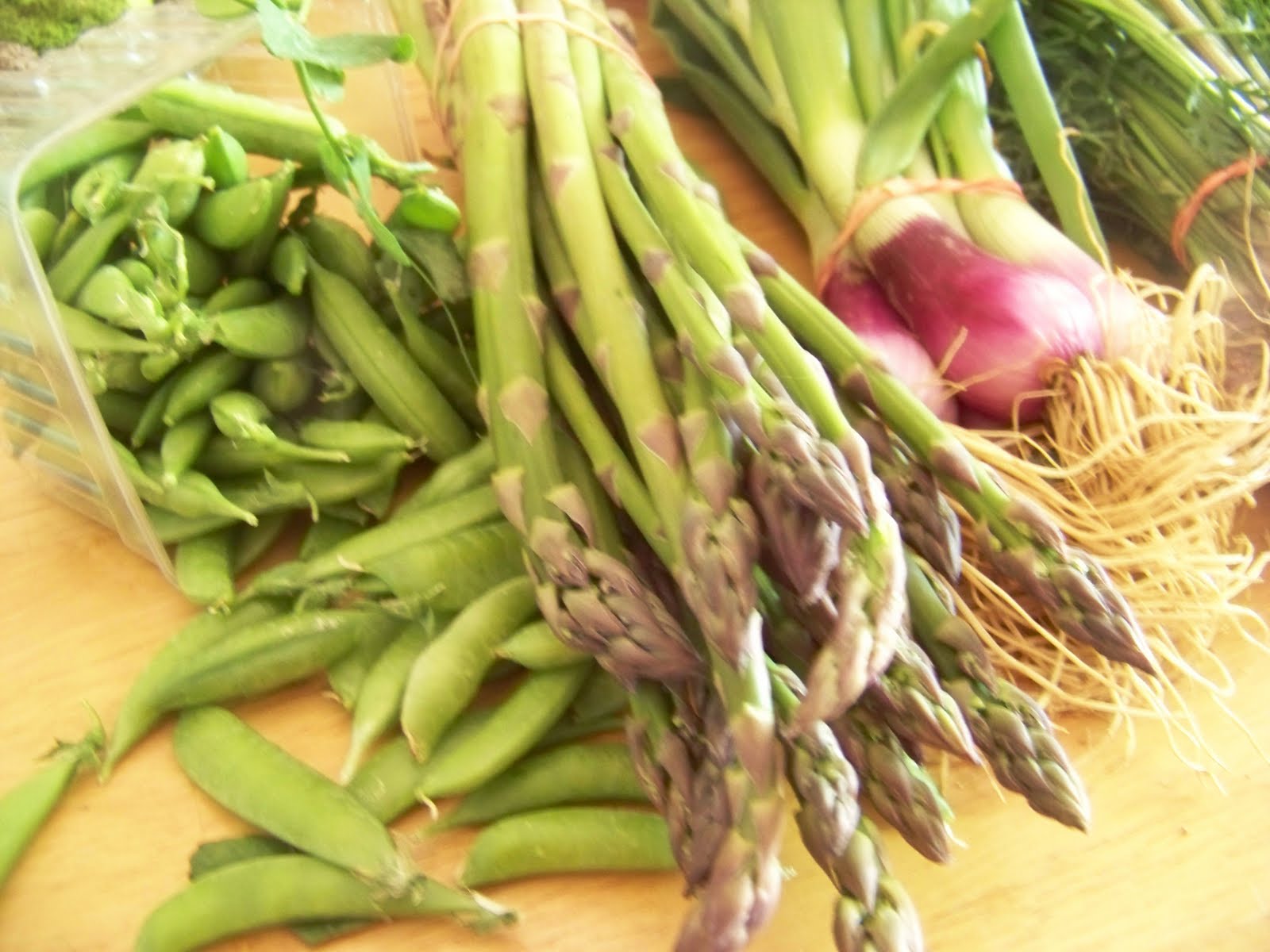
This potent green flashed in my eyes as I drove to the farmer's market, hoping that I might at last find some fresh vegetables and perhaps even some strawberries to dispel the doldrums of winter. And, happily enough, I did. Seduced by the offerings, I bought asparagus, spring onions, peas, fennel, and some ugly little purple carrots.


These may not be at the peak of their flavor, but they have the gift of newness, of being the first green foods to present themselves as miracles of sun and soil and rain. Now, what to do with them? Perhaps try one of Bittman's recipes for the asparagus? With the fresh Haskins bacon that I also purchased at the market? And what of the peas? A sweet addition to a nice pasta, perhaps? Or a stirfry? Perhaps a salad with the carrots?  And what of the fennel bulb? It's not a vegetable I am familiar with, but I am always excited to experiment, to try something new. The spring onions will of course add flavor to all these, and the green tops color. Most important is to have a light touch, to treat this lovely, fresh produce with gentle reverence, allowing their essential selves to sing.  

And what of strawberries, any luck there? Happily yes. Some bumpy, imperfect red beauties. These gems are too special to mess about with at all. Perhaps a few specks of sugar to bring out their flavor. Or even a tiny dusting of white pepper. Again, a light touch to allow their own true nature to shine.   

That's the beauty of real, fresh food, in season: You don't have to do much with it to make something extraordinary.  

Thursday, April 28, 2011

Where are the spring goodies? I've waited, haven't I?

In May, two of the farmer's markets closest to me will be opening up again, and I can't wait. Hopefully I will finally get some of the goodies I have been waiting so anxiously for, in particular, asparagus and strawberries.  Mark Bittman just posted a chart of various methods of cooking asparagus with some delectable variations. (Actually the graphic posted with the article would make a great poster: Get on it, NYT.) I am anxious to try at least a few of those variations, especially steamed with brown butter (I mean, it's butter, c'mon) and, of course, roasted with bacon. (I could go on all day about bacon, but I will try to restrain myself. I mean, seriously though, bacon...oh yeah, I was going to restrain myself.) I've got another favorite recipe for asparagus that came from the April 2001 issue of Bon Appetit magazine that involves roasting the asparagus and serving it with crumbled goat cheese, crumbled bacon, some lemon zest, and a drizzle of olive oil. So good. (You can find a more detailed recipe here.)

And then, of course, strawberries will be coming in soon. I finally had to cave and buy some organic strawberries shipped all the way here from California to eat with breakfast tomorrow morning (yes, yes, yes, I have decided to be ridiculous / have some fun and try to have crumpets and tea with strawberries and clotted cream to celebrate the royal wedding). My son (four) and I shared a few before dinner, and they were good, but definitely missing that otherworldly, almost savory quality that local, roadside-stand strawberries have. They were pretty though and not too big. The best strawberries are always small. (In fact, those giant strawberries that you sometimes see in the grocery store are octaploids, which means they have eight sets of chromosomes. That's why they get so big, but they are never so tasty.)

While waiting for the spring deliciousness to become abundant at the supermarket, I continue to work on depleting my freezer and pantry. Today's experiment was with red quinoa, a grain that I have never tried before in any form, but I thought that Heidi Swanson of the blog 101 Cookbooks might have some guidance for me, and indeed she did. I found this recipe, which I decided to riff on using the ingredients that I had at home. Instead of asparagus and walnuts, I dug a small piece of pork tenderloin out of the freezer, defrosted it, sliced it as thin as I could and marinated it in a combination of soy sauce, honey, lemon juice, garlic, ginger, dried lemongrass, one piece of star anise, black pepper, and coriander (the last four or five ingredients were sort of tossed in there with an attitude like, well, that's kind of Asian-y, right? I am afraid I am not at all expert with Asian flavors). Then, while cooking the quinoa according to package directions (it takes little longer than the time it takes to cook parboiled rice), I sliced carrots into matchsticks and an onion into slivers, stir-fried the veg in a wok with just canola oil, put that aside and stir-fried the meat, and finally put it all together. I served the stir-fry with the quinoa as a replacement for rice, for which it served its purpose adequately. To be honest, the flavor of the quinoa was pretty nondescript to me, nearly as bland as parboiled rice. The smell of the quinoa was a bit stronger, almost greener (not entirely in a pleasant way), however the little snap of the grains between my teeth was pleasant and kind of addictive. I don't love it, but I will probably try it again.